Polyurea Window Cills
Select your construction type to find the right cill, then add to your enquiry
Engineered for Performance
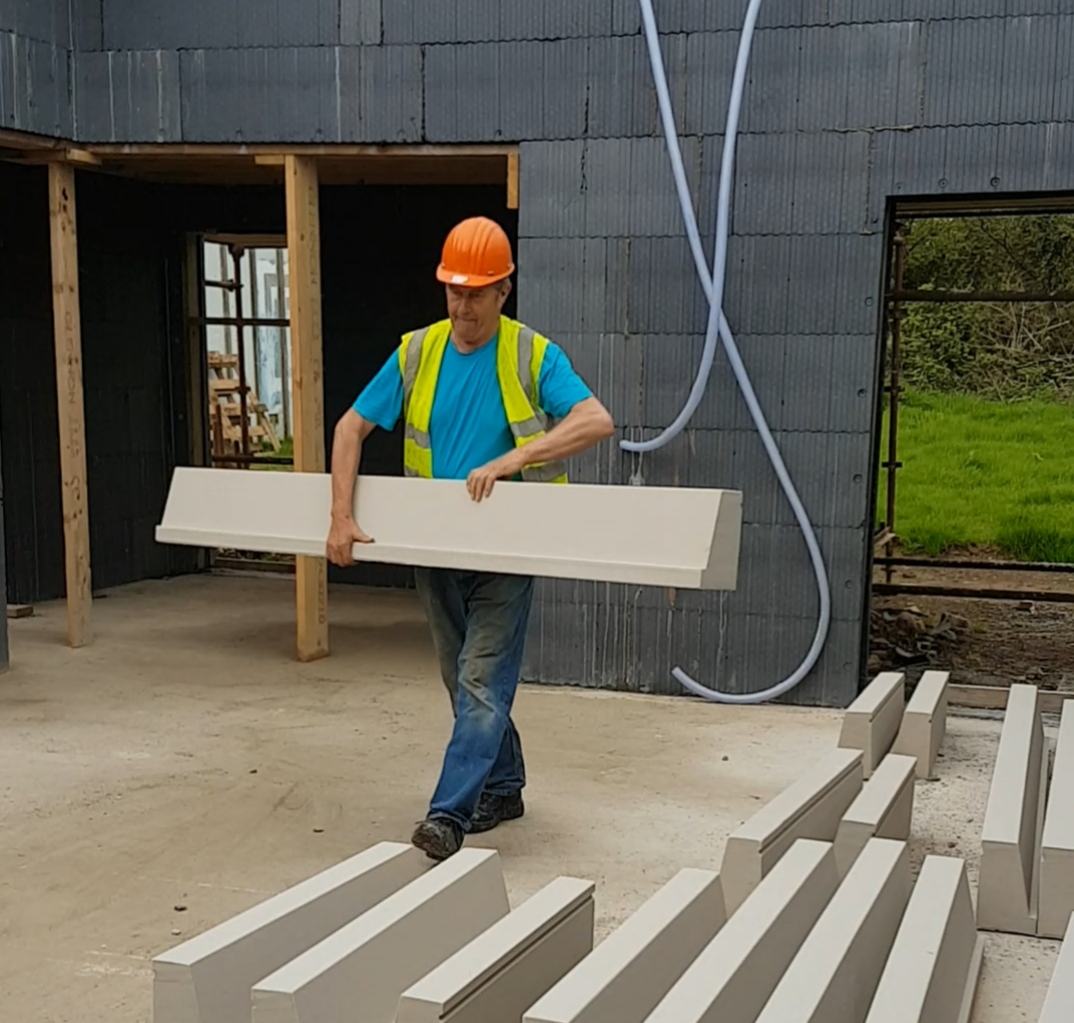
Manufactured from ultra-high-density EPS core with a durable polyurea finish — approximately 10% of the weight of a traditional concrete or stone sill.
Available in black, white, cream, RAL 7015 (slate grey) and RAL 7016 (anthracite grey). Paint on site to any colour — no sealant required.
- CE certified — compliant with Irish & UK building regulations
- Improves BER rating through reduced cold bridging
- Withstands up to ½ tonne per linear metre
Available Finishes
Sill Product Finder
Follow the guided steps to find the right sill for your construction type, insulation depth and cladding, or enter your measurements directly.
Find the right sill
Select your construction method, or jump straight to the universal finder if you already know your measurements.
Sill Profile Dimensions
Full Sill Dimensions
All 32 profiles — search by code or filter by sill width (mm).
| Product Code | Sill Width (x) ▲ | Sill Height (y) | Front of Sill (R) | Upstand Width (z) |
|---|---|---|---|---|
| P44 | 155 mm | 85 mm | 65 mm | 15 mm |
| P13 | 170 mm | 140 mm | 90 mm | 15 mm |
| P32 | 175 mm | 75 mm | 50 mm | None |
| P20 | 185 mm | 150 mm | 90 mm | 75 mm |
| P43 | 190 mm | 100 mm | 50 mm | 15 mm |
| P14 | 200 mm | 150 mm | 90 mm | 25 mm |
| P15 | 200 mm | 135 mm | 90 mm | 60 mm |
| P35 | 200 mm | 75 mm | 55 mm | None |
| P2 | 225 mm | 135 mm | 90 mm | 25 mm |
| P23 | 225 mm | 145 mm | 90 mm | 25 mm |
| P21 | 225 mm | 150 mm | 90 mm | 25 mm |
| P9 | 225 mm | 135 mm | 90 mm | 50 mm |
| P19 | 235 mm | 120 mm | 50 mm | 70 mm |
| P3 | 235 mm | 150 mm | 90 mm | 40 mm |
| P30 | 240 mm | 120 mm | 65 mm | 35 mm |
| P24 | 250 mm | 90 mm | 70 mm | 15 mm |
| P40 | 250 mm | 150 mm | 90 mm | 25 mm |
| P1 | 250 mm | 150 mm | 90 mm | 50 mm |
| P4 | 265 mm | 150 mm | 90 mm | 20 mm |
| P17 | 270 mm | 100 mm | 75 mm | 20 mm |
| P42 | 275 mm | 150 mm | 90 mm | 50 mm |
| P33 | 285 mm | 140 mm | 100 mm | 80 mm |
| P6 | 300 mm | 150 mm | 90 mm | 50 mm |
| P26 | 310 mm | 110 mm | 75 mm | None |
| P46 | 325 mm | 150 mm | 70 mm | 25 mm |
| M271 | 330 mm | 100 mm | 100 mm | 135 mm |
| P7 | 350 mm | 150 mm | 90 mm | 50 mm |
| P8 | 400 mm | 150 mm | 90 mm | 50 mm |
| P37 | 420 mm | 150 mm | 80 mm | 75 mm |
| P10 | 450 mm | 150 mm | 90 mm | 50 mm |
| M254 | 550 mm | 150 mm | 90 mm | 50 mm |
| P45 | 600 mm | 150 mm | 90 mm | 50 mm |
Need a profile or length not listed? Contact us — bespoke sizes available on request.
Ready to specify CCRM window cills?
Order a sample box, request a project quote, or browse installation products to complete your build.
Frequently Asked Questions
Last updated: November 2026
Do all windows need a cill (sill)?▾
Yes — every window needs either a projecting cill or an equivalent drainage detail to comply with Building Regulations. CCRM's cill range uses a polyurea finish, chosen for flexibility and weather resistance over the building's lifetime.
What size window cill do I need?▾
Size depends on wall thickness and finish: standard cavity walls typically use 150mm, while rendered or thicker walls often need 225mm or more. Our team can confirm the right size from your wall build-up drawings.
What's the difference between a cill and a sill?▾
No material difference — 'cill' is the term commonly used locally in Ireland and the UK, while 'sill' is more common in the US. Both external cills and matching internal window boards are covered under the same range.
Why does a cill project outward from the wall?▾
So rainwater drips clear of the wall face instead of running down the brick or render, preventing staining and long-term damp penetration.
What's the difference between an internal and external cill?▾
An external cill is angled and weatherproof, shedding water; an internal cill (window board) is flat and decorative, finishing the inside reveal.
Can a cill be replaced without replacing the whole window?▾
Yes, in most cases — though it's best done alongside a full reseal of the window junction for the tightest weatherproofing.
Why choose a polyurea cill over traditional GRP?▾
Polyurea is more flexible and UV-stable than standard GRP, resisting the cracking and brittleness that shorten the service life of older fibreglass products.
Are these cills suitable for commercial specification projects?▾
Yes — CE marked and manufactured to consistent tolerances suitable for both residential and larger commercial projects.